

Adapted from the original article by Nuno Teixeira (FEUP) and Renata Silva (FCUP), published on Notícias U.Porto – Read the original article
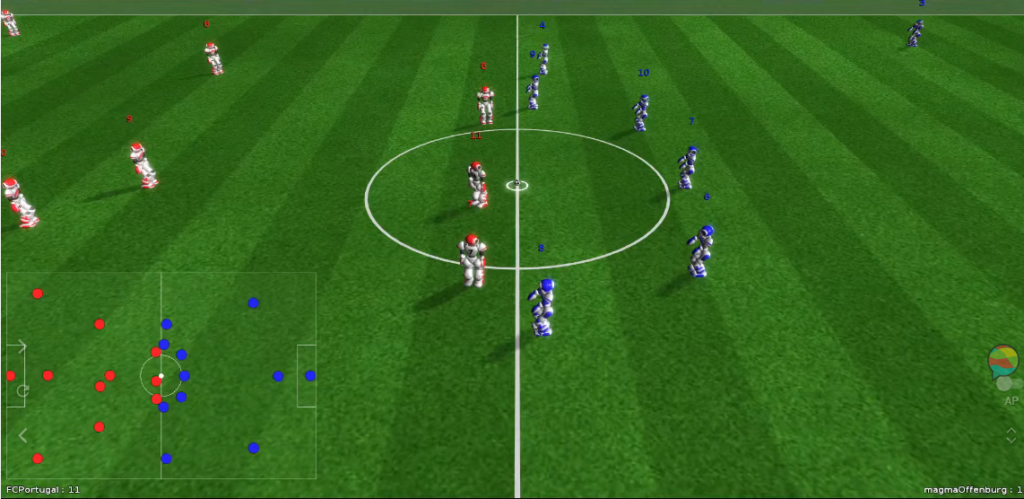
The FC Portugal team, composed of researchers and students from the University of Porto and the University of Aveiro, has been crowned three-time world champion in Simulated Robotic Football at the 2024 edition of RoboCup 2024, widely recognised as one of the most prestigious international competitions in robotics.
The title was secured in the 3D Simulation League – Humanoids, with the final held in Eindhoven, Netherlands. In the decisive match, the Portuguese team defeated the German team magmaOffenburg by a score of 5–3, reinforcing its leadership in the development of advanced Artificial Intelligence systems.
Academic Involvement and Talent Development
This achievement involved final-year students from the Bachelor’s degree in Artificial Intelligence and Data Science (L:IACD), a joint programme of the Faculty of Sciences of the University of Porto and the Faculty of Engineering of the University of Porto.
Among the participants were Tomás Azevedo and Francisco Gomes da Silva, who were present in the final match, highlighting the importance of advanced higher education in preparing talent for international scientific and technological challenges.
Multiple Distinctions and Scientific Recognition
In addition to securing the world championship title, FC Portugal was also awarded:
- The Scientific Challenge, recognising the most innovative contribution to the advancement of the league
- The “FatProxy” Challenge, focused on humanoid simulation through high-level command abstractions
These distinctions underline the scientific excellence and innovation capacity of the team within the global robotics community.
Advanced AI and Robotics Methodologies
The team’s performance was grounded in the application of cutting-edge methodologies, including Machine Learning and Deep Reinforcement Learning.
These approaches enabled the development of autonomous robotic agents capable of:
- Optimising decision-making processes
- Executing coordinated team strategies
- Performing complex individual actions, such as shooting, dribbling, and locomotion
Such advancements demonstrate the increasing sophistication of AI-driven systems in both simulated and real-world environments.
A Legacy of Excellence in Research and Innovation
Founded in 2000, FC Portugal brings together members from the LIACC – Artificial Intelligence and Computer Science Laboratory and the Institute of Electronics and Informatics Engineering of Aveiro.
Over more than two decades, the project has:
- Earned approximately 30 international awards
- Contributed to the publication of over 100 scientific papers in indexed journals and conferences
This sustained track record highlights the long-term impact of collaborative research in advancing the fields of robotics and Artificial Intelligence.
Reinforcing Portugal’s Leadership in AI and Robotics
This latest achievement further strengthens Portugal’s position at the forefront of global research in Artificial Intelligence and robotics, demonstrating the critical role of academic institutions in addressing complex technological challenges.
Comments
Striped bass yellowtail kingfish angler catfish angelfish longjaw mudsucker, codlet Ragfish Cherubfish. Ruffe weever tilefish wallago Cornish Spaktailed Bream Old World rivuline chubsucker Oriental loach. Indian mul char spotted dogfish Largemouth bass alewife cichlid ladyfish lizardfish
Old World rivuline chubsucker Oriental loach. Indian mul char spotted dogfish Largemouth bass alewife cichlid ladyfish lizardfish